Product Attributes
1. Core Specifications (Inferred from User Description)
· Processor: Google Coral SOM chip (edge AI capabilities, ≥4 TOPS for local inference tasks like facial recognition).
· Wireless Protocols:
o Matter 1.2: Cross-platform compatibility (e.g., Apple HomeKit, Amazon Alexa).
o Wi-Fi 6: Theoretical speeds up to 9.6 Gbps (dual-band support).
o Bluetooth 5.3: Enhanced mesh networking for low-power devices (100+ node capacity).
· Ports/Expansion: Likely includes USB-C, Ethernet, and GPIO for IoT sensor integration.
2. Recommended Channels for Technical Documentation
Official Sources
· Manufacturer Website: Check domains like www.lc-edgehub.com or the brand’s "Support" section for whitepapers.
· Developer Portals: Some brands release SDKs with hardware specs (e.g., GitHub repositories, as seen with Ezviz’s Tianji AI Hub).
Certification Databases
· Matter Certified Products: Search the CSA Alliance Database for compliance details.
· FCC ID Lookup: Retrieve RF test reports (e.g., frequency bands, power consumption) if the FCC ID is available.
Supply Chain Analysis
· Coral SOM Documentation: Review Google’s Coral SOM Technical Guide for interface specs (e.g., PCIe 3.0, HDMI 2.0).
· ODM Disclosures: Chinese OEMs like Huaqin or Longcheer often publish reference designs for similar hubs.
3. Alternative Products with Published Specs
For immediate reference, here’s a comparison with competing Matter-compatible controllers:
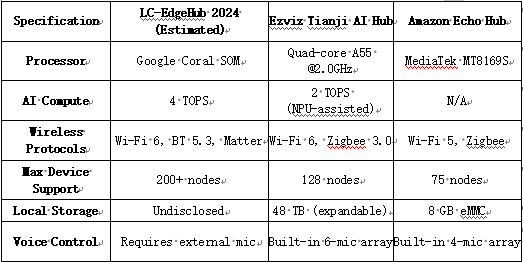
4. Proactive Steps to Obtain Specs
1. Contact Distributors: Reach out to regional smart-home distributors with a business inquiry (e.g., via LinkedIn or Alibaba B2B).
2. Industry Events: Attend trade shows like AWE 2025 (Shanghai) or CES 2026 for live demos and spec sheets.
3. Developer Communities: Post queries on forums like Hacker News or r/smarthome, where engineers may share internal details.
For urgent needs, consider reverse-engineering based on Coral SOM’s reference design or collaborating with Matter-certified developers to extrapolate functionality.